
Our account test: September 23, 2026
We used a dedicated trial account and fictional contact details in QRFY’s production application. Four specimens covered an editable website code, an independent copy with a scan limit, a styled static code and a public vCard. This is a partial account test, not a capacity or reliability benchmark.
| Scenario | Observed result | Scope |
|---|---|---|
| Change a destination | The same short URL reached the new page | Browser checks before and after saving |
| Rename, folder and duplicate | Original and copy had separate IDs and short URLs | Copy settings left the original intact |
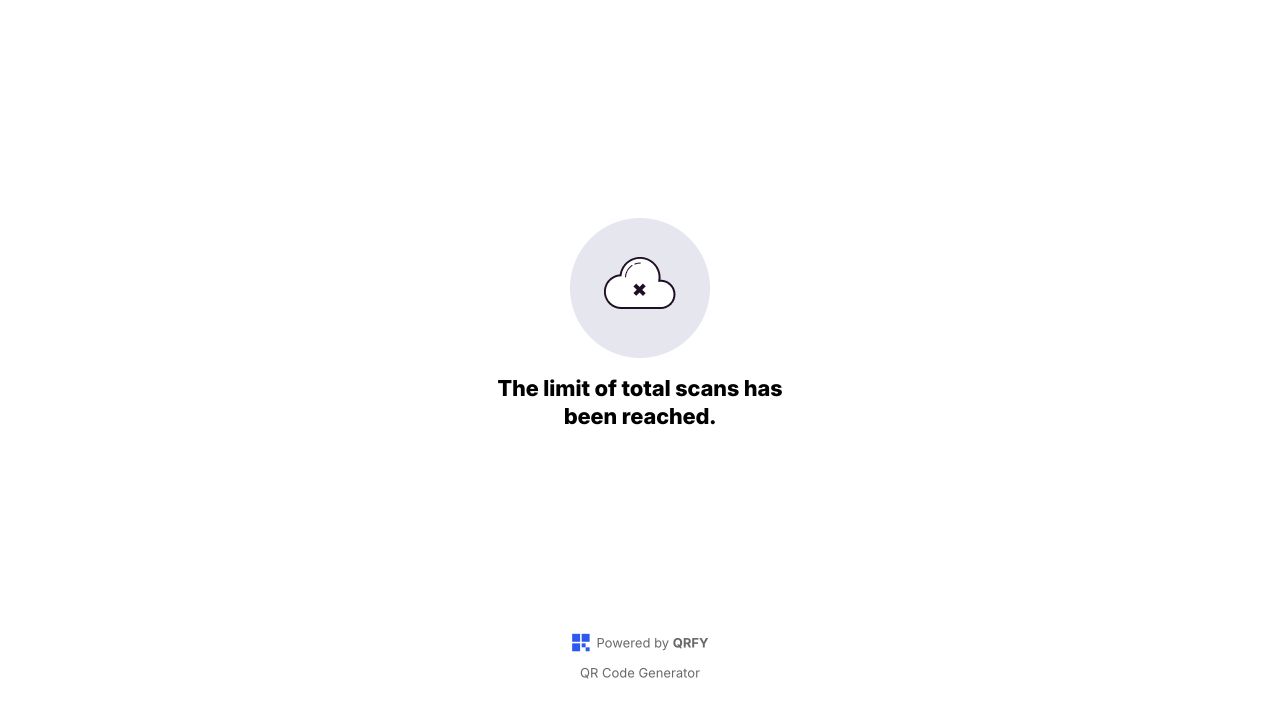
| Limit to one scan | First visit reached our page; second was blocked | Encoded URL opened in a browser |
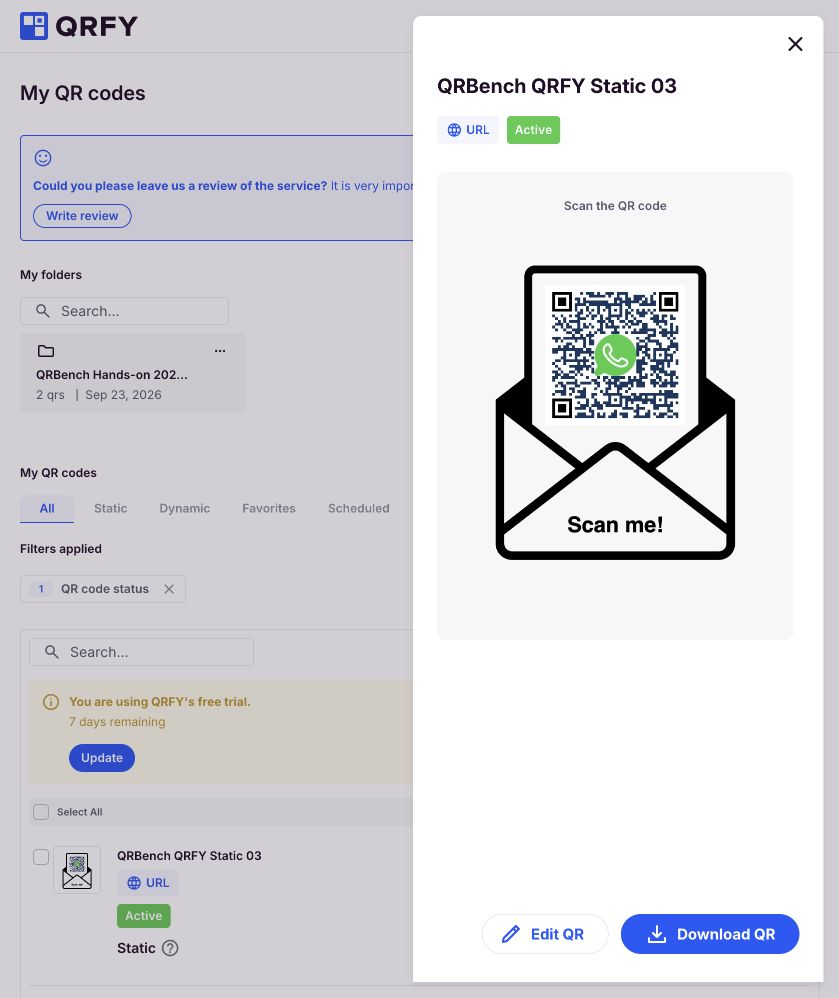
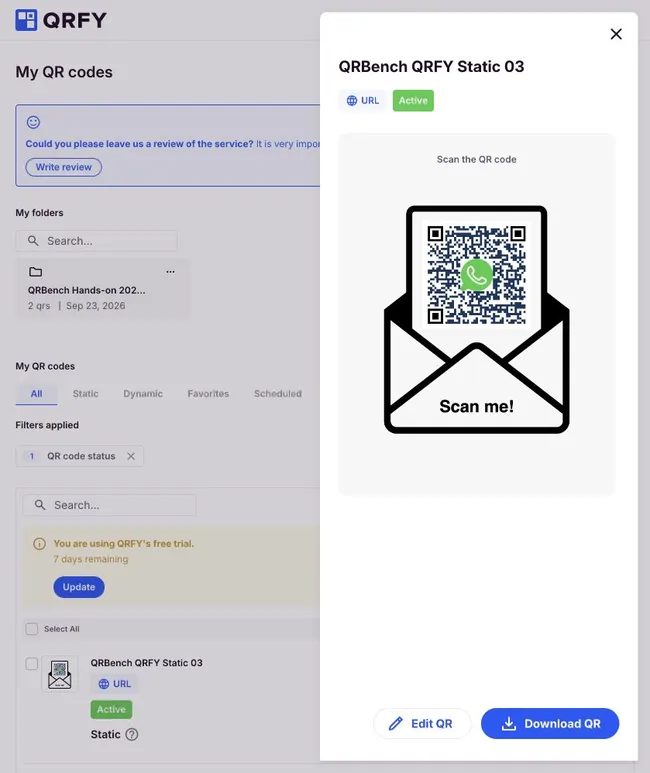
| Style a static code | Color, frame and built-in logo applied | Preview screenshot decoded to the direct destination |
| Public vCard | Fictional details displayed at 375px without horizontal overflow | Contact-file import not tested |
| Open exports | Account owner reported successful opening | Formats requested were PNG, SVG and PDF; response did not identify each separately |
The account owner scanned the original preview screenshot three times with the native Camera app on an iPhone 17 Pro and confirmed that the intended page opened. Those phone scans validate that displayed specimen. The exported files were not independently inspected or decoded by us, and we did not test printed output.
Creation and everyday management
Website creation follows a name-and-URL form, design options and a completion step. Renaming, folders and duplication worked in our session. Editing the name inline and editing the full code are separate controls; the latter sits in the Actions menu. Colors, frames, logos and error correction give more control than a bare URL generator.
The vCard builder uses several expandable sections. We created a public page with fictional details and checked its mobile layout. An email field did not retain our automated input, so we completed the specimen without an email. We have not reproduced this manually and do not classify it as a product defect. A Trustpilot review request appeared after the first QR; we did not submit a review.

The bulk workflow reached CSV upload and displayed a trial limit of 25 rows per file. We did not upload a batch. Country and language routing, scheduling, password protection, custom domains and tracking settings were visible, but their presence is not proof that those workflows work.
Scans appeared after a reporting delay
The final original-code dashboard showed six scans, nine visits and two unique scanners. Its OS breakdown showed three Mac OS scans and three iOS scans, matching our three browser openings of the encoded URL and the three phone scans declared by the account owner. The three extra visits corresponded to our preview openings.
That match took time to appear. At 10:10, the dashboard still showed only three Mac OS scans; at 10:15 it showed all six with the iOS breakdown. We did not measure latency from each scan. This small series supports the observed count and OS attribution, not a general claim of real-time accuracy or deduplication quality.
QRFY’s preview URL contains /r/; the actual encoded short link does not. In our checks, preview openings increased visits without consuming the copy’s scan quota. The first opening of the encoded link consumed its one allowed scan; the second reached the limit page.
GA4, Facebook Pixel and Google Tag Manager fields were available. We did not configure an integration or validate exported reports, history retention or location accuracy. Our analytics comparison separates tested behaviour from documented features.
Pricing observed in the account
The September 23 plans screen showed €19 per month for 12 months, €29 for six months and €39 for three months, excluding tax. The corresponding commitments are €228, €174 and €117. Twelve months was preselected. The entry cost is therefore a full quarter, even when the headline is a monthly equivalent.
The paid offer advertises unlimited dynamic codes, scans and users. Our trial usage screen instead showed 1,000 dynamic codes and five custom domains, with unlimited static codes, scans and users. These are displayed trial allowances, not measured capacity or verified paid-plan ceilings. We made no purchase.
Trial expiry and conflicting refund information
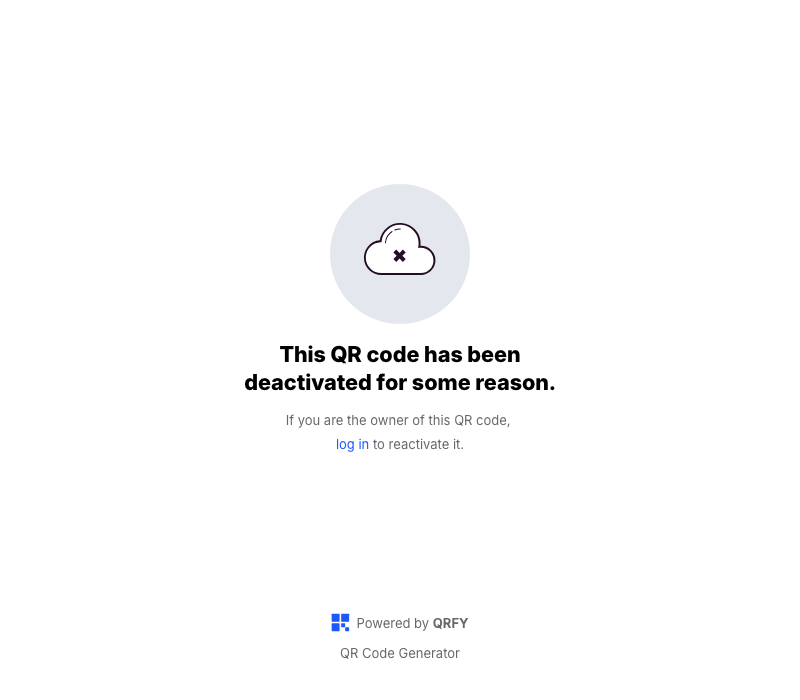
The public FAQ says the seven-day trial ends automatically and that codes are retained for three months but inaccessible until a plan is purchased. We checked this on our original dynamic specimen. On October 1, 2026, eight days after creation, its short link no longer reached our page: it redirected to qrfy.io/qr/invalid, which returned an HTTP 404 status and the page below. We had checked the code on September 23 and October 1 only, so the exact cut-off time is unknown.
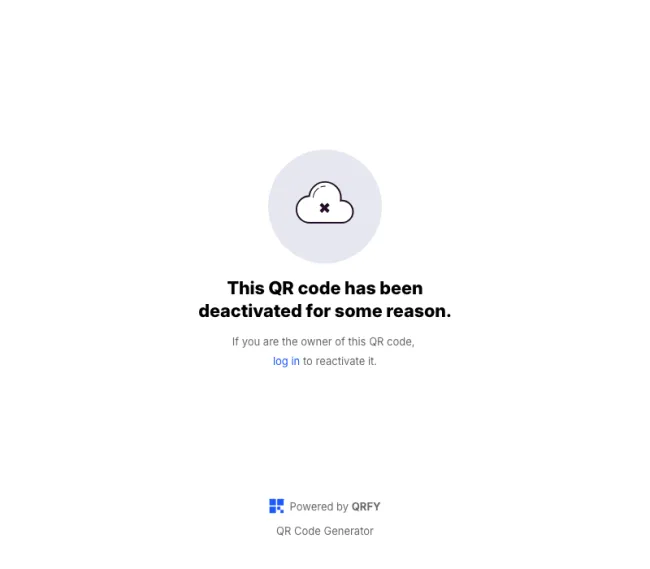
The page tells the person scanning that the code has been deactivated “for some reason” and invites the owner to log in. It does not mention the trial or a plan. We did not log in, pay or test reactivation, so the three-month retention remains documented only.
The static specimen is different: its decoded preview contains the destination directly, so resolving that pattern needs no QRFY redirect. This does not establish continued access to the static editor after the trial.
The terms, labelled March 25, 2026 and read on September 23, describe automatic renewal, cancellation with access through the paid period, and a 14-day withdrawal/refund window. The account FAQ describes a first-payment refund within 14 days if the service has not been used extensively. However, an older support article, dated February 17, 2023 and still accessible, says a subscription cannot be revoked for a refund. These statements conflict. We did not buy, cancel or request a refund, and cannot resolve how QRFY applies them in practice.
The current help centre is populated with sections on accounts, billing, design and analytics. Our old observation about a different help domain being empty does not describe this site. Support response time remains untested.
Correction, September 23, 2026. Our previous review said QRFY was dynamic-only and presented its refund restrictions too categorically. The account test confirms static creation, and the current terms describe a refund window despite the older help article. We have corrected those statements. Numerical scores are retained from the prior assessment; this update is not a full rescoring, and trust and support evidence needs reassessment before those ratings can be treated as freshly validated.
Update, October 1, 2026. The post-trial check above replaces our earlier note that this outcome was not yet observed. It matches QRFY’s documentation; numerical scores are unchanged.
Who should compare QRFY
QRFY is worth comparing for teams that expect enough codes to justify a multi-month plan. Our test supports common editing and management tasks, while bulk generation, API access and custom domains remain documentary or interface observations.
For a few codes or a short campaign, compare total commitment rather than the monthly headline in our pricing index. For an unchanging destination, QR Code Monkey offers a separate static workflow. For editable codes, our dynamic guide compares ongoing costs and what each provider documents about stopping payment. Our trial code stopped working once the trial ended, so do not print a trial code on material that must outlast it.